Mortar, Memory, and Mastery: The Regional Builders Who Gave Asyut Its Architectural Identity
When Americans think of Egyptian architecture, the mind tends to leap to the pyramids of Giza or the towering columns of Karnak. Yet some of the most consequential construction in Egypt's long history unfolded not along the Nile's northern stretch but deep in Upper Egypt, in the city of Asyut. Here, across more than two millennia, generations of skilled builders, masons, and engineers developed a regional architectural tradition that was at once deeply local and surprisingly cosmopolitan.
The Ptolemaic Foundation: Administration Carved in Stone
When the Ptolemaic dynasty consolidated its rule over Egypt following Alexander the Great's conquest in 332 BCE, it inherited a vast administrative apparatus that required physical expression. Asyut, then known as Lycopolis, served as a provincial capital and a critical node in the governance of Upper Egypt. The administrative buildings constructed during this period reflected a deliberate blending of Greek civic design with inherited Egyptian structural logic.
Local builders working under Ptolemaic patronage adapted the colonnaded public hall — a hallmark of Hellenistic civic architecture — to suit the intense heat of the Upper Egyptian interior. Rather than the open, airy peristyle courtyards favored in Mediterranean climates, Asyut's craftspeople favored deeper porticos, thicker limestone walls, and strategic orientation toward prevailing northerly winds. These adaptations were not merely aesthetic preferences; they represented hard-won knowledge about how to keep stone structures livable in an environment where summer temperatures routinely exceed 100 degrees Fahrenheit.
The limestone quarried from the cliffs surrounding Asyut provided an ideal building material — dense enough to retain coolness overnight, yet workable enough to permit the detailed relief carvings that Ptolemaic patrons demanded. Local masons developed specialized techniques for cutting and finishing this stone that were distinct from practices used in Lower Egypt, and evidence suggests these techniques were transmitted through guild-like apprenticeship networks that persisted for centuries.
Islamic Influence and the Reshaping of Urban Space
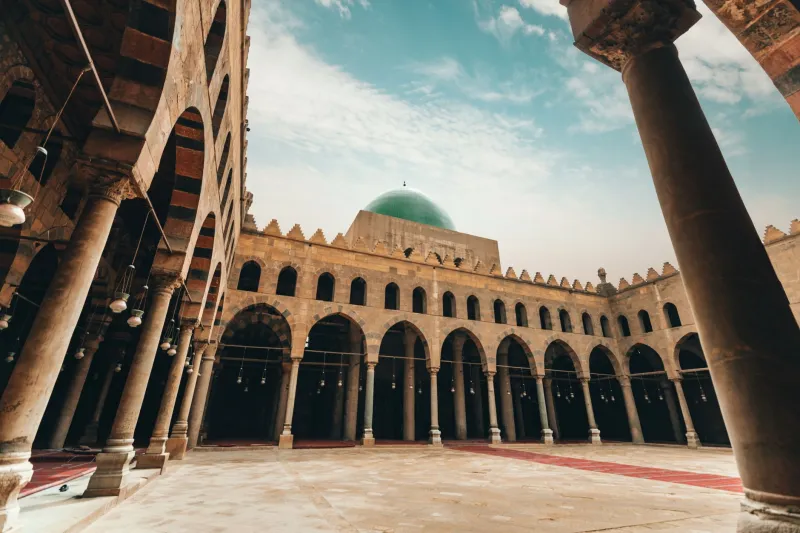
The Arab conquest of Egypt in 641 CE brought sweeping cultural and religious transformation to Asyut, and with it an entirely new set of architectural priorities. The mosque replaced the temple as the city's central organizing institution, and the urban fabric of Asyut began to reorganize itself around courtyard mosques, madrasas, and the winding residential lanes of the traditional Islamic medina.
Arab and later Mamluk builders who worked in Asyut faced the same climatic challenges as their Ptolemaic predecessors, but they brought different solutions. The mashrabiya — an elaborately carved wooden screen that allows air circulation while preserving interior privacy — became a defining feature of Asyut's merchant houses and residential buildings. Local woodworkers adapted this form, which had origins in Cairo and the broader Islamic world, using sycamore fig and acacia woods sourced from the Nile floodplain. The resulting screens displayed regional stylistic variations that specialists can now use to distinguish Asyuti craftsmanship from examples produced in other Upper Egyptian cities.
The courtyard house, another cornerstone of Islamic urban design, was similarly adapted to local conditions. Asyut's builders favored particularly deep interior courtyards with high surrounding walls that maximized shade during daylight hours while allowing heat to escape upward through natural convection at night. These design principles, refined over generations, gave Asyut's older residential quarters a distinctive spatial quality that urban historians have noted as unusually sophisticated for a provincial city of its size.
Ottoman Patronage and the Emergence of a Regional Style
The Ottoman conquest of Egypt in 1517 introduced yet another layer of architectural influence to Asyut. Ottoman administrative and military elites, eager to project authority across their newly acquired province, funded the construction of mosques, caravanserais, and public fountains throughout Upper Egypt. In Asyut, these projects created an unusual opportunity for local builders to work alongside craftspeople imported from Istanbul and the broader Ottoman world.
The result was a period of fertile architectural hybridization. Ottoman domed prayer halls appeared alongside older Egyptian-Islamic structural traditions. Local builders absorbed techniques for constructing shallow brick domes — a form more common in Anatolia than in Upper Egypt — and integrated them with the thick-walled, high-ceilinged rooms that had long characterized Asyuti construction. The caravanserai complexes built near Asyut's commercial center during the late Ottoman period were particularly notable examples of this synthesis, combining Istanbul-influenced arcaded courtyards with locally produced limestone detailing.
Perhaps most significantly, Ottoman-era Asyut saw the emergence of identifiable master builder families whose names appear repeatedly in construction records and endowment documents. These families functioned as repositories of accumulated technical knowledge, passing down not only practical building skills but also the mathematical and geometric principles underlying structural design. Some of these lineages remained active well into the nineteenth century, serving as a living bridge between the pre-modern craft tradition and the modernizing pressures of the Muhammad Ali era.
Climate Logic as Architectural Innovation
Across all of these historical periods, the most consistent thread in Asyut's architectural tradition was a sophisticated engagement with climate. Upper Egypt presents builders with a demanding set of environmental conditions: intense solar radiation, minimal rainfall, dramatic diurnal temperature swings, and periodic sandstorms driven by the khamsin winds that sweep northward from the Sahara each spring.
Asynt's master builders responded to these conditions with a toolkit of passive cooling strategies that anticipated principles now central to contemporary sustainable design. Deep window reveals reduced direct sunlight penetration while preserving views and ventilation. Roof surfaces were often treated with lime plaster that reflected solar radiation rather than absorbing it. Interior water features — modest fountains and basins found in the courtyards of wealthier homes — exploited evaporative cooling long before mechanical air conditioning existed.
These strategies were not the product of theoretical knowledge but of generations of empirical refinement, tested against the unforgiving reality of Upper Egyptian summers. Their effectiveness is demonstrated by the fact that many of Asyut's older buildings, now centuries old, remain more comfortable in summer heat than modern concrete structures built without reference to this inherited wisdom.
A Legacy Still Being Uncovered
Despite the significance of Asyut's architectural heritage, it remains comparatively understudied in relation to the more celebrated monuments of Luxor, Cairo, or Alexandria. Ongoing documentation efforts by Egyptian and international researchers are gradually producing a more complete picture of the city's built history, but much work remains.
For students of architectural history and urban design, Asyut represents something genuinely valuable: a case study in how skilled regional builders synthesized external influences without surrendering local identity. The city's master builders were not passive recipients of styles invented elsewhere. They were active interpreters, adapting and innovating in ways that left a durable mark on Egypt's urban landscape — a mark that, for those who know how to read it, is visible still.