The Long Way Home: Asyut's Displaced Antiquities and the Argument Over Who Keeps Them
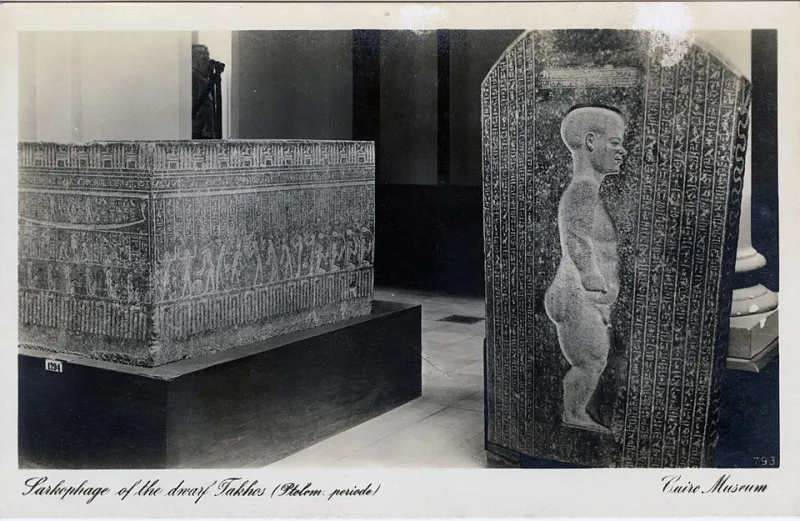
Photo: Unknown, CC0, via Wikimedia Commons
A Case in a Foreign Room
Walk into the Egyptian galleries of a major American museum and you will, almost certainly, be standing within a few feet of something that came out of the ground near Asyut. The Middle Kingdom and Late Period material from the cliffs west of the city — coffins, stelae, funerary models, pottery, and the small everyday objects that fill museum vitrines — has been dispersed across Europe and North America for more than a century. Institutional records at several US collections list Asyut as a findspot.
This is not a scandal hidden in a basement. It is the ordinary outcome of nineteenth- and early twentieth-century excavation practice. What has changed, and changed quickly, is the willingness of audiences on both sides of the Atlantic to treat that outcome as a question rather than a fact.
How the Objects Left
The mechanics were legal at the time, which is precisely why the debate is difficult. Under the division-of-finds system administered by the Egyptian Antiquities Service, foreign excavation missions received a share of what they uncovered in exchange for funding and carrying out the work. Egyptian law was amended in 1983 to end that practice, and subsequent tightening has made the export of antiquities effectively prohibited.
The international framework followed a similar arc. The 1970 UNESCO Convention on the Means of Prohibiting the Illicit Import and Export of Cultural Property set a widely cited cutoff date, and the United States implemented it through the Cultural Property Implementation Act in 1983. Objects that left Egypt before that line occupy a different legal category from those that left after it — a distinction that museums rely upon and that critics regard as a technicality dressed as principle.
The last two decades have added substance to the critics' case. American institutions have returned gilded coffins, statuary, and assorted artifacts to Egypt after provenance investigations revealed forged documents or false ownership histories. Each restitution strengthens the argument that the paperwork of the past is not always as clean as it appears on a label.
What Cairo Argues
Egyptian archaeologists and officials advance several overlapping claims, and they are worth separating.
The first is legal and moral: that a national heritage belongs with the nation that produced it, and that the division of finds reflected an asymmetrical relationship between a colonial power and a subject territory rather than a fair exchange.
The second is contextual. Objects displayed in Cairo, or in the regional museums that Egyptian authorities have been developing outside the capital, sit within a continuous narrative that a single vitrine in Ohio cannot reproduce. The recent reconfiguration of Egypt's museum landscape has sharpened this point, giving curators a stronger answer to the familiar question of whether source countries can care for their own material.
The third is about research access. Egyptian scholars argue that objects held abroad are sometimes difficult to study, that publication lags, and that the loan relationships governing access run in one direction only.
The Stewardship Counterargument
Museums and their defenders rarely argue that ownership is beyond question. Their case rests instead on three pillars: preservation, access, and universality.
Preservation is the oldest argument and the weakest in 2026. It once meant climate-controlled storage in cities far from regional conflict; today it reads as a claim about institutional competence that Egyptian conservation laboratories can credibly contest.
Access is more substantive. A visitor in Chicago encounters Egyptian material who will never travel to Upper Egypt, and that encounter has measurable cultural value. The honest response is that digitization and long-term loan arrangements can deliver much of that benefit without permanent transfer — a model some European institutions have begun to test.
Universality is the philosophical claim, and the most contested. A world-culture museum frames objects as human inheritance rather than national property. Critics reply that universality has historically been claimed by the party holding the object.
How an American Reader Should Weigh It
The instinct to treat this as a binary — everything stays, or everything goes — produces bad answers in both directions. Three considerations cut through the noise.
First, distinguish acquisition channels. Material that left under the division of finds is a different problem from material that left through forged export papers. The second category requires no debate at all; it requires restitution.
Second, treat loans as the test rather than the concession. An institution confident in its stewardship should be able to send significant objects to Egypt for extended periods. Willingness to do so is a better indicator of good faith than any press release about partnership.
Third, take regional museums seriously. The strongest argument for return is not that Cairo wants everything, but that cities like Asyut have a claim to interpret their own archaeology. A returned coffin that ends up in a storeroom in the capital has satisfied a legal point and lost a cultural one.
Where the Argument Is Heading
The trajectory is clear enough. Egyptian requests have grown more coordinated, American provenance research has grown more rigorous, and public attention — driven by social media and by the reporting that follows restitution announcements — has made quiet acquisition harder to sustain.
What remains genuinely open is the form that resolution takes. Outright transfer, long-term loan, shared custody, and joint research agreements are all on the table, and different objects will suit different answers. The one position that no longer survives contact with the evidence is the assumption that the question will simply go away.
For a reader standing in an American gallery, the productive move is not guilt but attention. Read the label. Find the findspot. Ask when the object left and under what arrangement. A museum that answers those questions fully is doing its job. One that answers them with a paragraph of vagueness is telling you something too.