Small Change, Large World: What a Buried Purse Says About Asyut's Ancient Connections
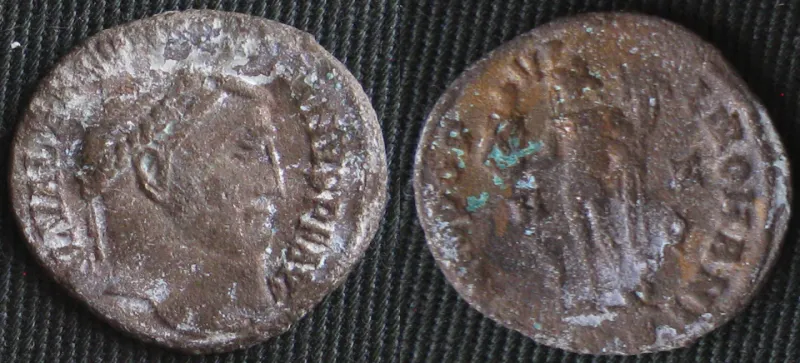
Photo: Waerloeg, CC BY-SA 3.0, via Wikimedia Commons
A Purse-Sized Puzzle
Archaeologists rarely describe a coin cache as glamorous. A hoard arrives as a cluster of corroded discs, sometimes fused into a lump, often cleaned in a laboratory rather than admired under glass. Yet when a cache of ancient coins came to light near Asyut, the first task was not to imagine treasure. It was to slow down.
Coins are small, portable, and easy to lose. That is precisely why they are useful. A tomb painting can show an ideal world; a coin can show the world people actually used. The Asyut-area cache belongs to that second category. Its value lies less in the metal than in the questions it raises: Who handled these coins? Why were they buried? What did they buy, and what did they prove?
Why Greek Money Ended Up in Upper Egypt
After Alexander the Great's conquests, Greek-speaking rulers governed Egypt for nearly three centuries. The Ptolemies issued coinage, collected taxes, paid soldiers, and connected Egypt to a wider Mediterranean economy. But connections on a map are not the same as connections in daily life. Coins help close that gap.
The Asyut region sat along the Nile corridor, a natural route for people moving between the Delta, Middle Egypt, and the south. Soldiers, tax officials, traders, pilgrims, and craftsmen all passed through. Some carried official silver or bronze. Others carried local imitations, older coins, or a mixture of both. A hoard can capture that mixture in a single deposit.
For a US reader, the closest comparison may be a coffee can of old bills found in a family attic. The individual notes are ordinary. The collection is revealing. It shows what was saved, what was spent, and what was considered worth keeping.
Reading Wear, Weight, and Mint Marks
Specialists examine coins in ways that can seem almost forensic. They record weight, diameter, metal composition, and the alignment of designs. They look for mint marks, countermarks, and signs of clipping. They study wear patterns to estimate how long a coin circulated. A coin that passed through many hands before burial tells a different story from one that went straight from a mint into the ground.
These details can point to trade routes and administrative habits. If coins from a particular mint appear repeatedly in Upper Egypt, that suggests regular movement rather than a single traveler's pocket. If local imitations appear alongside official issues, that suggests a flexible local economy in which trust and convenience mattered as much as imperial authority.
The evidence should not be overread. A hoard is not a census of the ancient economy. It is one deposit, made for reasons that may have been practical, ritual, or emergency-driven. Still, when combined with excavation records, pottery, and settlement evidence, coins can sharpen a picture that monuments alone leave blurry.
What Everyday Money Reveals That Tombs Cannot
Monumental tombs tell us how elites wanted to be remembered. They show grand ideas about power, afterlife, and cosmic order. Coins tell us something less heroic: how a farmer paid a tax, how a soldier bought a meal, how a merchant stored savings, or how a family hid valuables during an uncertain week.
ThatOrdinary quality is the point. The Asyut cache helps historians think about the region not only as a place of temples and necropolises but as a working landscape of markets, roads, and households. It also reminds us that globalization is not a modern invention. Long-distance exchange existed, but it moved at the speed of donkeys, boats, and human feet.
For AsyutWiki, the lesson is straightforward. A coin hoard is not a treasure story. It is a document written in metal, and it deserves the same careful reading as an inscription on a temple wall.
A Hoard for the Present
In 2026, museums and archaeological authorities face familiar questions about how such finds should be studied, displayed, and protected. The best answer is not to turn the cache into spectacle. It is to publish the context, train local specialists, and explain the evidence in plain language.
Small change, in other words, can carry large meaning. The coins buried near Asyut do not shout. They trade, travel, and save quietly—and that is exactly why they are worth hearing.