Between the Cliffs and the River: The Birdlife That Makes Asyut a Working Field Station
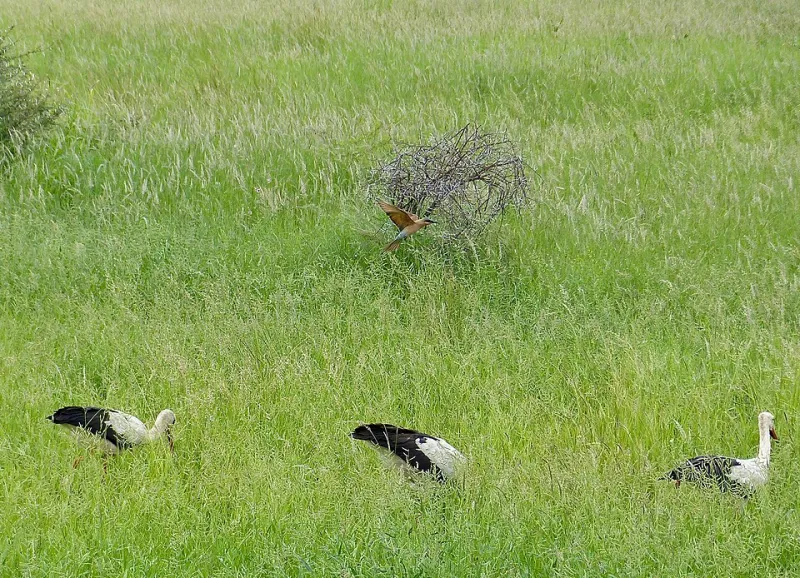
Photo: Bernard DUPONT, CC BY-SA 2.0, via Wikimedia Commons
The Nile between Asyut and the desert is not a single habitat but a compressed stack of them: open water, mudflats, irrigated fields, palm groves, canal banks, rubbish edges, and then, abruptly, a wall of limestone cliff. For a bird flying north in spring or south in autumn, that stack is a corridor with food, cover, and rising air all in the same place.
This is what makes Asyut a quietly excellent place to watch migration, and a frustratingly underdocumented one. The great flyways of the world — the Mississippi, the East Asian–Australasian, the Palearctic–African route that passes here — are monitored by networks of counters, banders, and databases in Europe and North America. Middle Egypt sits squarely on one of those routes, yet systematic counts along this stretch remain sparse and discontinuous.
A Corridor, Not a Postcard
Migration through Upper Egypt follows the river because the river is the only reliable water and the only dependable band of green for hundreds of kilometers in either direction. Birds that winter in sub-Saharan Africa and breed in Europe or western Asia must cross the Sahara, and the Nile Valley functions as a funnel: narrow enough to concentrate birds, wide enough to feed them.
Asyut adds a feature the valley elsewhere lacks in quite the same form. The cliffs of the western bank provide updrafts and thermals that soaring birds exploit to gain altitude with minimal energy. Raptors and storks that would otherwise flap their way north can ride the lift instead.
What Moves Through, and When
Spring passage runs roughly from March into May; autumn from September through November. The timing shifts with weather, and a strong dust event can ground birds for days before releasing them in a visible surge.
Among the most conspicuous travelers are white storks, often moving in loose flocks that circle over the fields before drifting north. Black kites, steppe buzzards, booted eagles, and the occasional Egyptian vulture use the escarpment as a highway. Herons and egrets — little egret, cattle egret, squacco heron, night heron — work the canal margins, joined in season by glossy ibis. Bee-eaters and swallows pass in loose, noisy bands. Wading birds spread across wet field edges and the shallows, while resident species such as the pied kingfisher, hoopoe, and spur-winged lapwing hold territory year-round.
The variety rewards slow looking. A field that appears empty from a car window will often yield three or four species to someone standing still with binoculars for twenty minutes.
The Cliffs as a Raptor Highway
The western escarpment is where the drama concentrates. On a warm morning with a light southerly, birds lift off the valley floor and spiral upward along the rock face before gliding north. Observers positioned on high ground can watch them gain hundreds of meters without a single wingbeat.
That same terrain is unforgiving. Cliff-nesting species are sensitive to disturbance, and quarrying, road building, and unregulated access all reduce the number of quiet ledges.
The People Counting
Egypt has a small but persistent community of ornithologists, many affiliated with universities and conservation organizations, and a growing amateur birding scene equipped with apps. Platforms such as eBird and iNaturalist have made it possible for a single observer with a phone to contribute a record that enters a global dataset, and identification tools have lowered the entry barrier for beginners considerably.
For a biology student in Asyut, that combination is unusually favorable: accessible habitat, a long migration window, and free tools. What is missing is coordination — a repeatable route walked on repeatable dates, generating comparable data year after year. A handful of committed volunteers could produce more useful information than a single well-funded expedition.
Pressures That Do Not Make Headlines
The threats along this corridor are cumulative rather than catastrophic. Illegal hunting of migratory birds remains a documented problem along the Nile Valley, particularly for songbirds and waterbirds. Power lines and uninsulated distribution networks cause collisions. Wetland loss, pesticide use in irrigated fields, and the conversion of canal banks to concrete all reduce foraging habitat. Disturbance from unregulated recreation pushes birds off roosting sites.
Climate change adds an unpredictable layer, shifting the timing of passage relative to the availability of food at stopover sites — a mismatch that can matter more than any single local threat.
Why Asyut Is an Easy First Trip
For a visiting birder, Asyut offers something that premier sites in East Africa and southern Egypt do not: proximity. The valley habitats sit within a short drive of a city with hotels and transport, and the cliffs are visible from the riverbank. A visitor can spend a morning on the corniche, an afternoon along irrigation channels, and an evening watching storks settle, without an expedition budget.
That accessibility is exactly what ecotourism requires, and exactly what makes careful management necessary. Birding tourism works when it is quiet, guided, and predictable; it fails when it becomes a scramble for photographs.
What Responsible Visits Look Like
Stay on tracks. Keep distance from nesting cliffs, especially in spring. Avoid playback during migration, when birds need to feed rather than defend territory. Never disturb a flock to get it airborne. Use a local guide where one is available, and log what you see — the record is worth more than the photograph.
Asyut will probably never appear on the cover of a birding magazine. But a valley that funnels birds between two continents, watched by students with phones and binoculars, is a field station in everything but name. The counting is what turns it into one.