Counting Stars Above the Cliffs: A Field Guide to Asyut's Night Sky
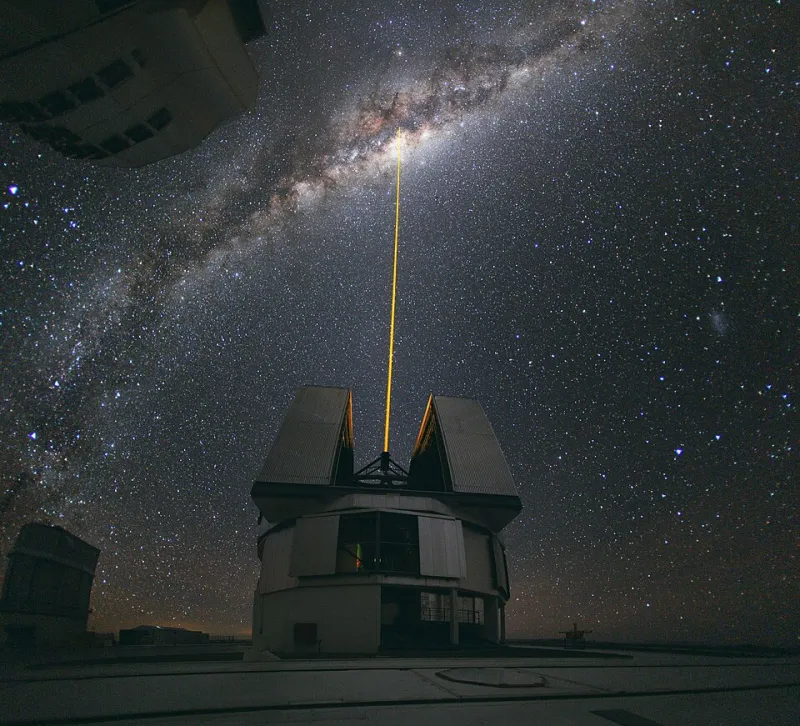
Photo: ESO/Yuri Beletsky (ybialets at eso.org), CC BY 4.0, via Wikimedia Commons
Drive west from the Nile bridge at Asyut on a clear winter night and keep going until the city's glow flattens into a dull orange band behind you. What opens up ahead is the thing astronomers spend careers chasing: a horizon unbroken in three directions, air that has shed most of its moisture, and a Milky Way that reads as a textured band of dust and light rather than a faint smear.
Asyut is not a famous name in observational astronomy. It has no mountain observatory, no published sky-brightness atlas, and no dark-sky certification. That is precisely what makes the governorate worth a closer look. It is a large, well-connected, densely populated place with a desert attached to it — an uncommon combination that could serve Egyptian science education and, in time, a modest astrotourism economy. What follows is a field guide to what the sky here actually offers, how it stacks up against protected sites in the United States, and what stands to be lost if nobody bothers to measure it.
A Sky Shaped by Dry Air and Flat Ground
Astronomers separate two qualities that casual stargazers tend to merge. Transparency describes how much light gets through the atmosphere; seeing describes how much the atmosphere smears it. Asyut scores well on the first for much of the year. Annual rainfall is negligible, and relative humidity stays low outside the late-summer months, which means less water vapor to scatter light and soften faint stars.
The second quality is more variable. Desert ground releases heat rapidly after sunset, and the resulting turbulence near the surface can blur fine detail for telescopes pointed low in the sky. Observers who wait until the small hours, when the boundary layer settles, generally get steadier images. Dust is the other wild card: the spring khamsin winds can lift enough particulate matter to turn a pristine sky into a hazy brown dome for days at a time.
Seven Features That Matter to Observers
1. Low humidity across most of the year. From roughly October through April, the air over Upper Egypt is dry enough that dew heaters are a luxury rather than a necessity. That same dryness makes faint nebulae and the zodiacal light easier to see than they would be in a humid climate at the same latitude.
2. An uncluttered western horizon. The settled Nile Valley lies to the east, which means the darkest part of the sky sits over open desert. Deep-sky observers care about this more than they care about raw darkness overhead.
3. Genuine darkness within an hour of the city. Asyut's urban core is bright, but the gradient falls off quickly. A drive of thirty to fifty kilometers into the Western Desert puts an observer in skies that, by informal estimates, would land somewhere in the middle of the Bortle scale — faint but visible Milky Way structure, some sky glow along the horizon.
4. A predictable winter high. The same stable air masses that make Upper Egypt's winters pleasant produce long runs of cloudless nights, which matters when you are planning a school program or a multi-night observing campaign rather than a single holiday evening.
5. Elevated ground close at hand. The limestone cliffs on the western bank rise abruptly from the valley floor and offer both a raised platform and a physical barrier against light from the valley towns.
6. A university and school system next door. Assiut University, founded in the 1950s, and a dense network of secondary schools sit within reach of dark skies. That proximity is a resource most rural observatories would envy.
7. Logistics that do not require an expedition. Asyut is roughly 375 kilometers south of Cairo, served by rail, road, and an airport, with hotels, fuel, and medical facilities. A visiting astronomer from the United States can reach a genuinely dark site here with less preparation than a trip to Chile's Atacama demands.
How Asyut Compares With America's Dark-Sky Parks
American readers often calibrate darkness against places like Cherry Springs State Park in Pennsylvania, Great Basin National Park in Nevada, or Big Bend in Texas. Those sites share two features Asyut lacks: decades of published sky-quality measurements, and formal protection written into land-use policy. Their darkness is documented, defended, and monetized through tourism.
The comparison is instructive rather than discouraging. A desert site outside Asyut is unlikely to match Big Bend's remote core, where the nearest substantial city is hours away. But it may well rival the sky over a mid-tier American park — and it sits beside a population that could actually use it.
The Slow Erosion: Light
The threat is not dramatic. It arrives as unshielded streetlamps, as white LED replacements installed for cost reasons rather than optical ones, as floodlights on industrial sites, and as villages that grow outward along the desert road. Egypt's steel, cement, and sugar installations around Asyut run around the clock, and their glare reaches farther than most people assume.
Without a baseline, none of this can be argued about with evidence. A modest program — a handful of Sky Quality Meter readings taken at fixed points through the year, run by student volunteers — would cost less than a single telescope and would give planners something to work with.
If You Go: Notes for Visitors
Plan around the new moon. Late autumn and winter offer the best combination of clear skies and tolerable nighttime temperatures; summer nights are warm but workable, while spring carries the risk of dust. Bring layers, because desert nights in January drop sharply, and bring more water than you think you need. Red headlamps only, and no white light once eyes have adapted. Travel advisories for Upper Egypt change, so check current guidance and consider a local guide for desert routes.
Beyond the Telescope
There is a cultural argument here as well as a scientific one. The sky was a working calendar for the civilization that built the tombs in these cliffs, and the decans that structured Egyptian timekeeping are part of the region's intellectual inheritance. A dark sky is also simply a public good — a thing that cannot be manufactured and, once spoiled, cannot be bought back.
That is the quiet case for taking Asyut's night sky seriously. Not because it is the darkest place on Earth, but because it is a dark place where people already live, teach, and study. Those are the skies that shape whether a generation looks up at all.