A City That Sings for Days: Understanding Asyut's Moulid Season
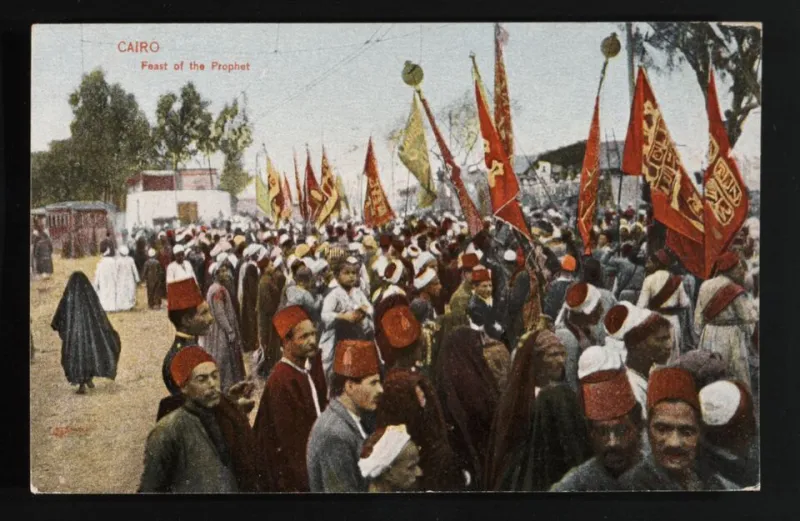
Photo: Cairo Postcard Trust, CC BY-SA 2.5, via Wikimedia Commons
More Than a Street Fair
A moulid can look, to an outsider, like a festival that has spilled out of a fairground and into a city. There are lights, vendors, crowds, and music. But the moulid is not primarily a tourist event. In Asyut and across Upper Egypt, it is a religious occasion tied to local saints, Sufi orders, family traditions, and the social life of neighborhoods.
The word itself is connected to the Arabic term for birth, and many moulids commemorate holy figures. Celebrations vary by place and by community. Some emphasize processions; others emphasize recitation, prayer, or nights of collective remembrance. In Asyut, the moulid season brings these elements into the streets, where religious devotion and civic identity are difficult to separate.
For a US audience, it may help to imagine a county fair, a church homecoming, and a family reunion compressed into a week of public observance—except that the sacred element is not decorative. It is the reason people come.
The Sound of the City
Sound is often the first thing visitors notice. Amplified chants mix with drums, horns, and the murmur of crowds. Processions move through streets that were not designed for them. Vendors call out prices. Children run between adults. Families claim patches of sidewalk and wait for relatives.
Sufi processions can include flags, recitation, and rhythmic movement. The atmosphere is not uniformly solemn. There is laughter, bargaining, and the ordinary business of feeding a crowd. That mixture can confuse outsiders who expect religion to be quiet or confined to a building. In Asyut, as in much of Egypt, public religious life is social life.
Food plays a supporting role rather than a leading one. Street stalls sell sweets, nuts, grilled food, and tea. Families may prepare food at home and share it with guests. The point is hospitality, not spectacle. A visitor who buys a cup of tea and watches from a respectful distance will learn more than one who pushes toward the center of a procession.
A Visitor's Guide to Respect
The most useful advice for outsiders is simple: follow local cues. Dress modestly. Ask before photographing people, especially during prayer or ritual moments. Do not block a procession to get a better shot. Avoid drones and flash photography unless you have explicit permission. Keep children close in dense crowds.
Visitors should also resist the urge to treat the moulid as a photo opportunity. A sacred procession is not a parade staged for tourists. If you are unsure whether you may enter a particular space, ask a local organizer or a trusted guide. In some settings, separate seating or gathering areas are observed. Respect those boundaries without making a show of your discomfort.
There is also a practical dimension. Crowds can be intense, streets may be closed, and noise levels can be high for hours. Travelers with sensory sensitivities or mobility concerns should plan accordingly. The best visits are usually shorter, calmer, and arranged with local advice rather than improvised at the last minute.
Why Moulids Matter to Asyut
The moulid is not only a religious observance. It is an economic and social engine. Vendors earn income. Families renew ties. Young people participate in organized groups. Local institutions coordinate logistics. The event also reinforces a sense of place: Asyut is not merely a dot on a map between Cairo and Luxor. It is a city with its own calendar, its own saints, and its own ways of gathering.
In 2026, as in previous years, the exact dates and scale of celebrations depend on the religious calendar and local arrangements. Visitors should check current local guidance rather than relying on old schedules. That is not a small point. A respectful visitor plans around the community's rhythm, not the other way around.
The Right Kind of Attention
Asyut's moulids deserve attention, but not the kind that turns devotion into theater. The right approach is curious, patient, and modest. Listen more than you photograph. Buy from local vendors. Ask questions at the edges of an event rather than in the middle of a ritual. Accept that some parts of the celebration are not meant for you.
A moulid is a city singing in its own key. Visitors are welcome to hear it, but they should not try to conduct.