What It Takes to Turn Asyut's Sunlight Into Power: Five Figures Worth Knowing
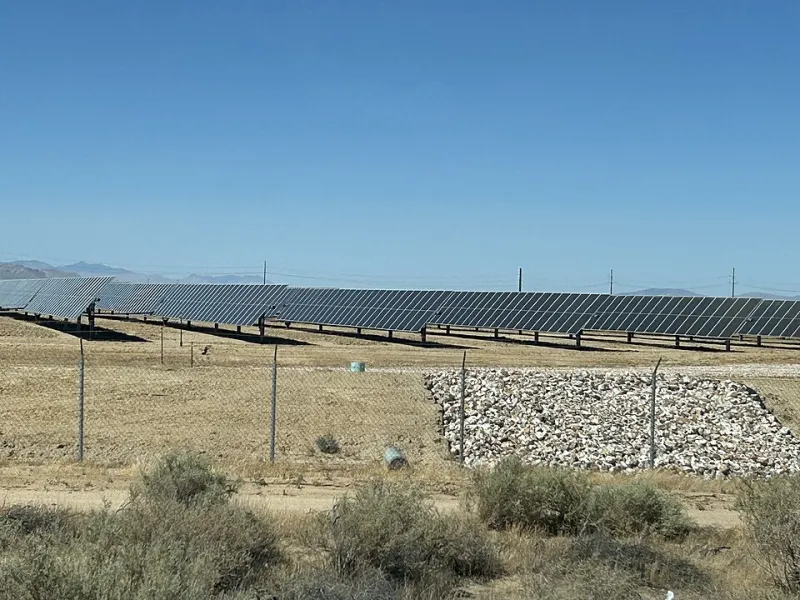
Photo: TheUltimateGrass, CC0, via Wikimedia Commons
A City Positioned for Photons
Asyut occupies a narrow, sun-bleached shelf of the Nile Valley roughly 375 kilometers south of Cairo, at about 27 degrees north latitude. That placement matters. The city sits within one of the planet's great clear-sky belts, where cloud cover is rare, humidity is low for much of the year, and the atmosphere scatters comparatively little of the light that reaches the ground. For engineers sizing a photovoltaic plant, this is close to ideal terrain.
For American readers, the comparison is useful. Phoenix, at 33 degrees north, receives something on the order of 2,000 kilowatt-hours per square meter of global horizontal irradiation in a typical year. Asyut's figure runs higher, and its share of direct-beam sunlight — the component that tracking systems and concentrating technologies can exploit — is higher still. What follows are five numbers that sketch the outlines of the region's solar ambitions, and the practical constraints that sit behind them.
One: Roughly 2,300 Kilowatt-Hours per Square Meter
This is the annual resource, measured as global horizontal irradiation, and it is the single figure that determines whether a solar project is worth pursuing at all. A site in this range can support capacity factors well above what a typical utility-scale plant achieves in Germany or the northeastern United States, where comparable installations often operate in the high teens as a percentage of nameplate capacity.
The consequence is arithmetic. A plot of desert in Asyut Governorate produces more electricity per panel, per dollar of mounting hardware, and per hour of inverter operation than the same plot would in a cloudier climate. That advantage is why Egypt's national solar buildout has concentrated in the south, and why developers continue to study Upper Egypt even when transmission constraints and financing costs complicate the picture.
Two: 45 Degrees Celsius, and What Heat Costs a Panel
Peak summer afternoon temperatures in Asyut routinely approach 45°C (113°F), and module temperatures run hotter still — often 25 to 30 degrees above ambient. This is the counterintuitive part of solar engineering: panels are rated at 25°C cell temperature, and their output falls as they heat. A typical crystalline-silicon module loses roughly 0.35 to 0.40 percent of its rated power for every degree above that reference point.
Run the numbers and a hot afternoon in Asyut can shave something close to 8 to 12 percent off a plant's output precisely when demand is highest. The design response is familiar to engineers in Nevada and the California desert: elevated mounting for airflow, careful inverter selection, and, increasingly, bifacial modules that harvest reflected light from bright ground. The human dimension matters too. Construction and maintenance crews cannot work through midday in July, which compresses the schedule and raises labor costs.
Three: 15 to 25 Percent Lost to Dust
Dust is the quiet tax on desert solar. Airborne sand settles on glass, and in a region where the khamsin winds of spring can carry grit for days, soiling losses can climb into the low double digits between cleanings. The industry default in dry climates is to accept something between 15 and 25 percent cumulative loss and clean on a schedule that balances recoverable energy against the cost of cleaning.
Here Asyut's constraints compound. Water is scarce and expensive, and wet cleaning of hundreds of thousands of panels is hard to justify on either economic or environmental grounds. The direction of travel is toward dry methods: robotic brushes that traverse rows at night, and coatings that discourage adhesion. These are the same solutions being tested in Arizona and the Permian Basin, where water availability has become a live constraint on solar operations.
Four: Four to Six Acres for Every Megawatt
Land is Asyut's least expensive input and its most complicated one. Fixed-tilt ground-mounted systems typically occupy four to six acres per megawatt of capacity, meaning a 100-megawatt plant requires a parcel of several square kilometers. Desert land in Upper Egypt is cheap by international standards — a sharp contrast with the permitting and real-estate costs that dominate solar economics in densely settled parts of the United States.
But desert here is not empty. It holds grazing routes, limestone outcrops, archaeological deposits, and the informal pathways that connect villages to markets. Siting therefore becomes an exercise in negotiation as much as engineering. The American parallel is siting on federal land in the Mojave, where the cheapest acreage is often the most contested.
Five: 42 Percent — The National Target
Egypt has committed to a target of 42 percent renewable generation by the mid-2030s, and solar is expected to carry a substantial share of that. Asyut's contribution is not only generation but geography: the governorate sits along the transmission corridor that carries power from the southern deserts toward Cairo and the Delta, and its substations are nodes in the national grid.
That role invites the same question raised in the United States whenever a region becomes an energy exporter: who captures the value? A plant built on Asyut's outskirts sends electricity north. The jobs it creates are real but often temporary during construction, and the permanent workforce is small relative to the capital invested. Local content requirements, vocational training programs, and the siting of maintenance facilities are the levers through which a governorate can convert sunlight into durable employment.
Three Takeaways for US Readers
The first is that solar resource quality is not destiny. Asyut's irradiation advantage is substantial, yet heat derating and dust soiling consume a meaningful fraction of it, and those are engineering problems with engineering solutions that American operators are pursuing in parallel.
Second, water is the hidden variable. Any region that adopts dry cleaning and robotic maintenance early will find its desert solar economics more resilient than one that assumes unlimited washing capacity.
Third, the land question is unavoidable. Whether the site is a Nevada basin or a Nile Valley shelf, the cheapest land is rarely the unoccupied land, and the projects that endure are the ones that negotiate their footprint rather than ignore it.